

Associate of Science in Artificial Intelligence Systems Development
Artificial Intelligence Systems Development
The programme prepares students for further studies in a wide range of computer science degree programmes and employment in diverse industries. With a focus on AI system development, students learn skills in areas such as artificial intelligence concepts and development, object-oriented analysis and design, programming languages, software testing, and project management. We also emphasize the development of soft skills like problem-solving and teamwork.
Apply Now- Programme information
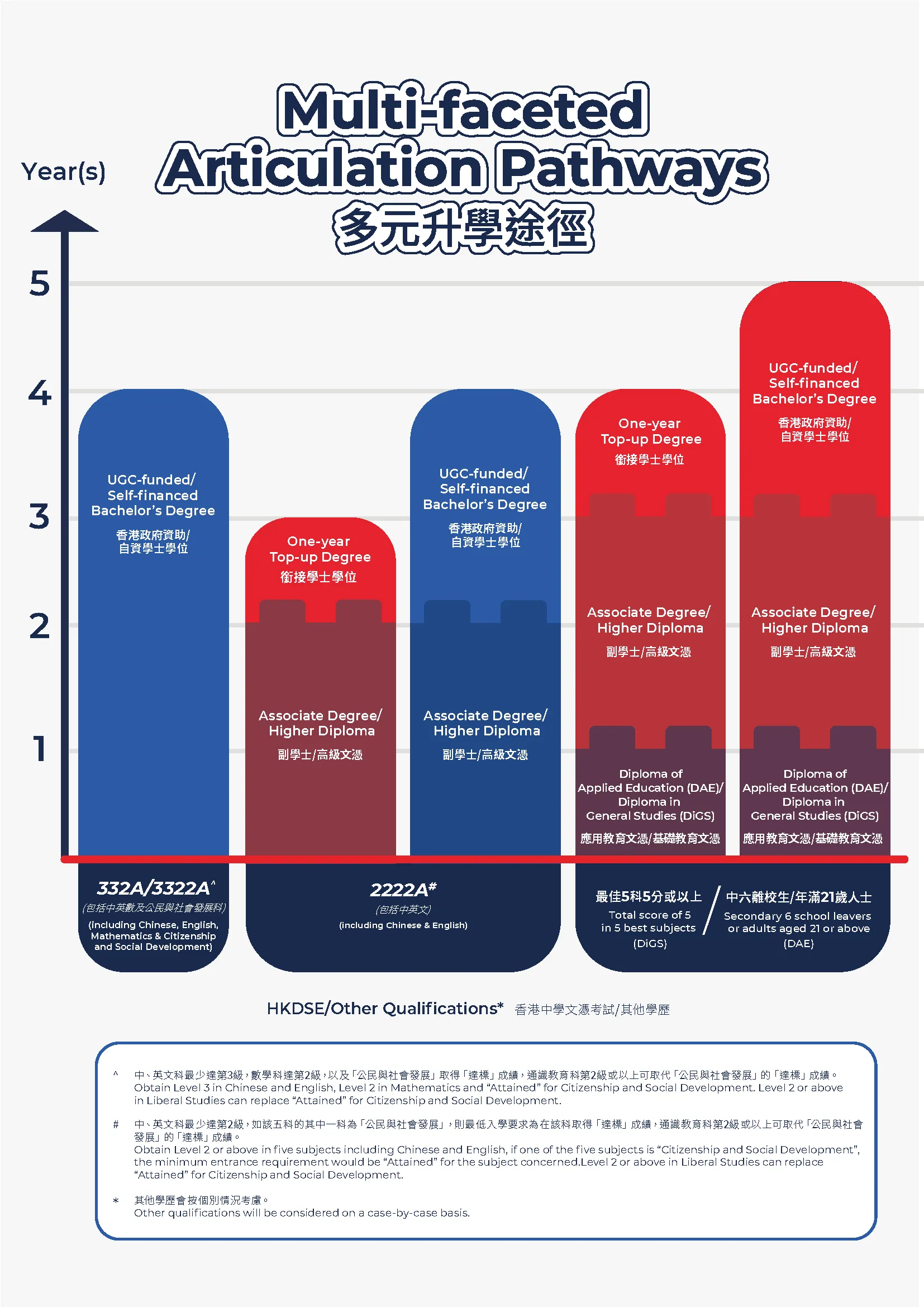
- Articulation Pathways
- Admission
- Entry Requirements
- Fees and financial assistance

| Faculty | Science and Technology |
| Programme | Associate of Science in Artificial Intelligence Systems Development Development (formerly Associate of Science in Information Systems Development) |
| Programme code | AScAISD |
| Campus | Tai Wai |
| Duration | 2 years |
| Credit units | 63CUs |
| Award type | Associate Degree |
| QR Ref/ Validity period |
26/000724/L4 01/09/2026-31/08/2029 |
-
For enquiries, please contact Faculty of Science and Technology (Telephone No: 2707 3232 or Email: uowchk-fst@uow.edu.au).
Applications can be submitted by the following methods:

Online Application
UOWCHK Admission Application Portal
(for all applicants with DSE/ NON-DSE / other qualifications, or mature applicants)
Click here for more information on admissions procedures.
Electronic Advance Application System for Post-secondary Programmes (E-APP)
(for HKDSE 2026/27 only)
By Post / In Person (Application Form)
No programme specific entry requirement. Please refer to General entry requirements
Fees
Application Fee
$150
Application fee is payable when applicants are invited for interviews. Application fee can be paid by the following methods:
- By direct deposit at any branch of the Hang Seng Bank or ATM transfer (Bank Code: 024) (A/C number: 359-300001-004) OR
- By Alipay, WeChatPay or credit card at the College Office's counter
Tuition Fee
Associate Degree Programmes
HK$2,000 per credit x
63 Credits required for Programme Completion
= HK$126,000
Higher Diploma in Social Work
HK$2,650 per credit x 44 social work courses credit +
HK$2,000 per credit x 15 general Education credit +
HK$2,650 per credit x 15 fieldwork placement credit
= HK$186,350
Other Fees
A Graduation Fee of $400 will be charged upon enrolment in a programme.
Financial Assistance
Students enrolled in self-financing Bachelor/Associate Degree /Higher Diploma programmes are eligible to apply for financial assistance from the following sources:
- Financial Assistance Scheme for Post-Secondary Students (FASP)
Provides means-tested financial assistance to needy full-time students pursuing locally-accredited, self-financing post-secondary education programmes at the level of associate degree, higher diploma or degree. The scheme aims to provide financial assistance to needy students so that no eligible students will be denied access to post-secondary education because of lack of means.
Enquiries: 2152 9000
Website: https://www.wfsfaa.gov.hk/en/sfo/postsecondary/fasp/overview.php
- Non-means Tested Loan Scheme for Post-Secondary Students (NLSPS)
The NLSPS is used to complement the Financial Assistance Scheme for Post-secondary Students (FASP) to provide loan(s) to eligible students to settle tuition fees of locally-accredited, self-financing full-time post-secondary education programmes at the level of associate degree, higher diploma or degree.
Enquiries: 2150 6222
Website: https://www.wfsfaa.gov.hk/en/sfo/postsecondary/nlsps/overview.php
- Continuing Education Fund (CEF)
Some of the AD programmes or course(s) in the AD programmes are included in the list of reimbursable courses for CEF purposes.
The CEF subsidizes students with learning aspirations to pursue continuing education and training courses without age limit. Eligible applicants enrolling on courses after 1 August 2022 will be reimbursed 80% of their fees on the first $10,000 and 60% on the second $15,000, subject to a maximum sum of HK$25,000 (whichever is the less), upon successful completion of a reimbursable programme/course(s).
Prior to 1 August 2022, the following condition will apply:
The CEF subsidizes students over 18 years of age with learning aspirations to pursue continuing education and training courses. Eligible applicants enrolling on courses between 1 April 2019 and 31 July 2022 will be reimbursed 80% of their fees on the first $10,000 and 60% on the second $10,000, subject to a maximum sum of HK$20,000 (whichever is the less), upon successful completion of a reimbursable programme/course(s).
Enquiries: 3142 2277
Website: https://www.wfsfaa.gov.hk/cef/en/index.htm
Programme structure and outcomes
- Learning outcomes & Main subject areas
- Programme study flow & structure
- Further Studies Pathways & Career prospects
Programme Intended Learning Outcomes (PILOs) are statements of learning achievement that are expressed in terms of what the learner is expected to know, understand and be able to do upon completion of a course. Students graduating from this programme will be able to:
| PILO | Description |
|---|---|
| 1. | Use a range of tools, programming languages, methodologies, and quantitative skills to undertake information systems development work; |
| 2. | Apply technical knowledge and skills, and well-proven software models and work responsibly as a team to develop secure, robust, and reliable quality business information systems; |
| 3. | Practise in an ethical and professional manner, and apply safety and health measures at work; |
| 4. | Communicate effectively, both orally and in writing, using English and Chinese in a culturally diversified workplace; |
| 5. | Examine the major socio-political, cultural and economic issues affecting information systems development in the local, national, regional and international contexts; and |
| 6. | Relate the major ideas in arts and humanities, science and technology, society and organizations to the study of Information Technology. |
- Information systems
- Computer programming
- Database systems
- System design methodology
- Language and general education

To qualify for this award, a candidate shall accrue an aggregate of at least 63 credit units by satisfactory completion of the following core courses.
| Course Code | Course Name |
|---|---|
| Programme Core (21CUs) | |
| AST10202 | Artificial Intelligence Fundamentals |
| AST20105 | Data Structures and Algorithms |
| AST20201 | Web Programming |
| AST20209 | AI Applications Development |
| AST20401 | Database Systems and Design |
| AST21105 | Object-Oriented Programming and Design |
| AST21209 | AI Project |
| Programme Core Elective - Sem B, Year 2 (3CUs) | |
| Select any one: AST20308 or AST20601 or AST21115 |
Cloud Administration and Virtualization or Computer Organization or Calculus |
| Broad-Based Knowledge (24CUs) | |
| AST10107 | Introduction to Programming for AI |
| AST10111 | Basic Calculus and Linear Algebra |
| AST10115 | Generative AI |
| AST10304 | Introduction to Computer Network |
| AST21111 | Discrete Mathematics |
| AST21119 | Ethics in Technology |
| AST21206 | Globalization and Sustainability |
| CGE23216 | Environment and Technology |
| Generic Skills (15CUs) | |
| CGE1000* / CGE1500 | English for Academic Studies A/B |
| CGE1200**# | Practical Chinese |
| CGE2003 | English Professional Communication Skills for Technology |
| CGE10413 | Hong Kong Society |
| CGE26515 | Understanding Contemporary China |
|
Please visit the General Education page for more details. |
|
|
* Students whose DSE score of English Language is below 3 are required to complete this course ** Students who are non-Chinese literate can take a course among the core General Education courses in lieu of CGE1200 Practical Chinese at the recommendation of Programme Leaders and approval by the Chairman of Academic Board # CGE1800 / CGE1900 Introduction to Spanish / French for non-Chinese speaking students only |
|
The table below is not exhaustive and only aims to show some examples of the bachelor's degree programmes offered by UGC-funded institutions and University of Wollongong, Australia which have admitted our past graduates. Our graduates also articulate to various overseas degree programmes offered in Hong Kong.
University of Wollongong, Australia
UOW College Hong Kong
City University of Hong Kong
- Bachelor of Engineering in Computer and Data Engineering
- Bachelor of Engineering in Information Engineering
- Bachelor of Science in Computer Science
- Bachelor of Science in Creative Media
Hong Kong Baptist University
- Bachelor of Science (Honours) in Computer Science
The Chinese University of Hong Kong
- Bachelor of Engineering in Computer Science and Engineering
- Bachelor of Engineering in Information Engineering
The Education University of Hong Kong
- Bachelor of Education (Honours) (Secondary) - Information and Communication Technology
The Hong Kong Polytechnic University
- Bachelor of Science (Honours) Scheme in Computing and AI (Computer Science / Financial Technology and Artificial Intelligence / Enterprise Information Systems)
The Hong Kong University of Science and Technology
- Bachelor of Engineering in Computer Engineering
- Bachelor of Engineering in Computer Science
The University of Hong Kong
- Bachelor of Engineering in Computer Science
- Bachelor of Science in Information Management
Graduates of this programme can pursue roles such as software developers, web developers, mobile app developers, database administrators, system administrators, and IT project managers. They can find jobs in various industries including business, engineering, web and app design, media computing, and the innovation and technology sector. The programme also provides a solid foundation for further studies in computer science or related disciplines, opening additional career pathways in research, academia, and advanced technology roles.
MO Yin Yi
Contact us
Faculty of Science and Technology
Phone / Whatsapp: (852) 2707 3232
Fax: (852) 2707 3231
Email: uowchk-fst@uow.edu.au